Friday, July 26, 2013

Don't Be An "Order Taker"

One of our community members sent me this today. It is SO TRUE! You know I love it. We should all follow this lady and get refreshed with wisdom as we learn to LOVE OURSELVES more and more every day...

From Sherrie Campbell, PhD
Loving yourself is the key to learning to think for YOURSELF. If you do not love yourself you cannot think for yourself. If you cannot think for yourself you cannot possibly make healthy decisions. If you cannot think for yourself then you become someone who simply follows orders. You end up doing what other people tell you to do instead of doing what you know in your gut is the right thing to do. 
If you are an 'order-follower' you are constantly operating out of fear and self-doubt. You have become so alienated from your own self that you are not comfortable anywhere around anyone and you have not clarity on who you really are. 
It is fascinating that the greatest damage is never created by people who love themselves and are risk taking. The greatest damage is caused by those who take orders (do what they are told to do). They drop reckless bombs and create massacres destroying the most precious and innocent things. 
Loving ourselves connects us to our OWN answers and those come from within not without. You should always question advice from the outside by balancing it against your inside and the bigger picture not the short-sightedness of 'winning' something. We all have the power to find our own answers and answers that come from this are not dangerous or harmful to others. They may help set boundaries but solutions are always involved as is the highest good for all involved. 
If you are simply taking orders the Universe will not be in your favor because you are not using your naturally given internal guidance system. The gifts of being self-loving only benefit all those whose lives you touch.

Thursday, July 25, 2013

5 Reasons Why Abused People Trust Those Who Are Unworthy

Abused people are often most loyal to those who are least worthy of it. Steven Brownlow, PhD

Why is that? Why do abused people remain loyal to unworthy people? Well, as a formerly abused person, I can give the answers to the reasons why an abused person would remain loyal to an unworthy person.

1. Abused people don't have emotional sensors to help them define unworthy treatment. 

An abused person is used to being hurt, exploited, disappointed, abused and disregarded. Poor treatment is customary for one who was abused in childhood. When you've never experienced positive, loving interactions, it is difficult to know the difference. You don't know what you're missing. When all you've ever known is abuse, you are attracted to that same abusive behavior--conditioned, so to speak to the abuse.

Learning to trust your instincts is difficult for the formerly abused person because they were denied access to their own feelings in order to survive the abuse from childhood.  It's like being on a road with no directional signs. You have to learn from scratch how to decipher different feelings in your heart in order to know what you're experiencing, and then you have to learn new skills for expressing your needs and setting boundaries. This is a monumental task as an adult! It's hard to make-up for many years of maltreatment, but it can be done. You can get free from abusive relationship patterns.

2. Abused people can experience repetition compulsion.

When all you've ever known is mistreatment, you have a psychological desire to right the wrongs of the past, plus, if you've always been treated bad, you may have learned to enjoy being treated that way.  This is called repetition compulsion (Freud), where you get in a relationship with a person like your abusive parent in an attempt to make them love you. It's all subconscious and leads to further pain for the abused person. In some respects, however, it actually feels good to be treated badly making it very difficult to break free from the cycle.

3. Abused people may feel unworthy of proper, respectful treatment.

Someone who was harmed as a child likely has been given the message by caretakers, and others throughout life that he or she is not worthy. As such, that person may not feel worthy deep down at the core. If you don't feel worthy, you will tolerate disrespect. If you do not feel worthy you will try to PROVE your worth to another person in order to EARN their love. Or, you may mold your desires to suit their wishes and whims and totally lose yourself, your identity in the process.

4. Abused people desperately need someone to love and trust, but don't know what trust is.

Abused people were not given the basic training manual on how to develop trust. Without someone to trust to begin with, how can you learn to trust? It's difficult, but not impossible with much dedication and diligence. If the abused person is not completely healed, and if he or she does not know their worth, they may trust someone prematurely with their valuable heart and soul. What the abused person needs is a road map, and lots of practice in knowing who and how to trust others.

5. Abused people are easily fooled.

An abused person has parts of them that are as naive as a child when it comes to relating with other human beings. That's because abuse stunts the emotional development of a person. The abused person's need for love and lack of protective warning sensors in their emotions makes them a sitting duck for abusive others. An abuser who gets out of exploiting others can easily get past that person's defenses and close to their heart where they can take advantage like a fox in the hen house. Afterall, if abused as a child, it's like growing up with the fox (exploiter) as a caretaker. Without the proper guidance and conditioning, the abused person is like a sitting duck.

Abused people lack the natural defenses needed to guide and protect them from further abuse. They may also be prone to self-sabotage. Defenses to trusting someone who is untrustworthy include:
  • Self worth / Self love
  • Assertiveness
  • Emotional maturity
  • Clear boundaries
  • Internal Support
Solution...

What can be done? How can someone who was abused stop the cycle of abuse as an adult? How can he or she turn back time and re-program their mind so they can stop trusting the wrong people who will only end up breaking their hearts and leaving them in pain?

1. Mindfulness

It's important that we all know what is going on with our own body, mind and soul. Mindfulness is a technique to help the abused person become more aware of their inner world and get more in tune
with their thoughts, feelings, emotions, needs and desires.

2. Emotional Clarity

The abused person must heal from the emotional hurts that were inflicted as a child through the releasing of pent up sadness, shame, anger and rage. These e-motions are simply "energy-in-motion" that must be processed to be resolved. Once you become in touch with these deep emotions, you are more emotionally available to yourself and these emotions are accessible to you for inner guidance.

3. Assertiveness

An abused person needs a huge dose of assertiveness, which I have found comes naturally when you get in touch with any repressed anger you hold inside during the emotional clarity process. Rage is an infantile emotion that develops into assertiveness, if one is raised properly. If not raised properly, rage turns inward and you become a doormat. If you want to get assertive, you need to get mad. You need to get mad at people who are out to abuse you and turn away from poor treatment immediately.

4. Reprogram Your Mind

If an abused person wishes to stop being drawn to untrustworthy people, he or she must get out of their comfort zone. They must create new neurological synapses that rewire their brains so that they are capable of one day being comfortable with positive treatment. Your brain has plasticity, so this is possible. It's not easy, but it is possible.

5. Set Boundaries

You must set limits and boundaries within yourself and outside of yourself with others. Boundaries are not easy to set when you come from an abusive background where boundaries were not allowed. Abusers hate boundaries! You must, however, overcome your tendency to merge psychologically with others and to lay down like a door mat. Your boundaries protect your identity and keep you safe and free from harm. It is your job to learn to set boundaries. Practice makes perfect!

What do you think? Are there any other things a person should do? I would love to hear from you. Please comment...

Wednesday, July 24, 2013

Fear or Love?

"Notice if your feelings & actions are coming from thoughts of fear or of love."
~ Dr. Margaret Paul 

If your actions are coming from a place of fear, then examine closely. you are likely feeling the need to control the perception that other people have of you. If you're operating from a place of fear, you are like an empty void, sucking up all that is around you. Fear is a place of need, a place of emptiness, hopelessness and insecurity. What are you afraid of? Examine:
  • Afraid the truth will come out that you are not worthy of love, that you are not enough?
  • Afraid that your relationship will end because there is no way you can ever be happy?
  • Afraid that your loved one will leave you?
  • Afraid you will be exposed in your weakness?
And if any of these fears form the core of your thoughts and feelings, you will have distinctly different actions and interactions than if you come from a place of love. What's more, you will likely end up getting the very thing you feared--rejection from the other person. This is because fear breeds rejection. Fear is the ultimate rejection of self; it is a lack of faith in your own efficacy in life. Fear breeds what it tries to hedge.

Fear Takes

Another issue alluded to above is the need to control. When you are in fear, instead of operating out of the purity and wholeness of love, you end up trying to control outcomes. This control takes on various manipulative forms. This control wreaks havoc on your relationships because it is indirect, non-authentic and a mask of who you really are and how you really feel. A person who is in fear may pretend to be super-strong, get super-angry, withdraw and/or hold affection. Fear causes you to engage indirectly, and may cause you to seek reassurance in those around you--the black hole effect.

Love Gives

But when you come from a place of love, it is a different story. Love offers up itself in truth and beauty. Love is not trying to GET anything in return--I learned this from Dr. Margaret Paul's teachings. Love doesn't need approval, doesn't need to make excuses for itself, doesn't need anything. Love is the opposite of fear because fear takes but love gives. Fear hides but love uncovers.

The key is being mindful during your interactions. Asking the right questions at the right moments can help you figure out where you're heart is and allow you to adjust your positioning in order to protect your precious relationships. Remember: Love builds, encourages and gives; fear destroys, rejects and takes.

Which will you choose this day?
 
Jenna R.

Tuesday, July 23, 2013

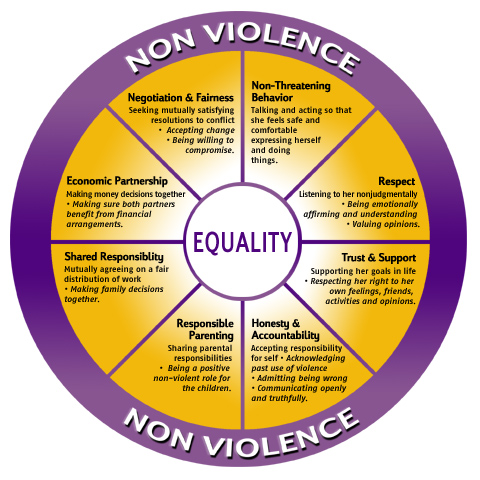
Non-Violence / Equality

Love This!!!


Equality in Dating Relationships Wheel


Power & Control Wheel


Relationship Rights

Relationship Bill of Rights 
by Divine Caroline

Have you ever thought about what a relationship should be … what a self-loving, self-respecting person is entitled to in a healthy relationship? Of course you have! I’ve addressed this in various dimensions in lots of other posts, but I thought it would be fun to draft a general relationship bill of rights. Mine can serve as a guide for you to begin one of your own, based on your particular experiences and ideals.

In my opinion, you are born with the inalienable right to a relationship that:

1. Lets you make mistakes. Everybody makes mistakes. Mistakes are human. Mistakes allow us to learn, to grow, and to become better as individuals and when done right as couples. In a healthy relationship, we must have the room to stumble and not be scorned for it.

2. Lets you be 100 percent yourself. A relationship worth staying in is one that you feel free to be all of the dimensions of you, all of the time. If a piece of is hibernating out of fear that it will not be accepted, then that piece will ultimately shrivel up and die, making you feel less than your complete worth.

3. Lets you to state your needs and have them met. Being assertive about your need-states is critical—how else can you get them met? By doing so you are honoring your rights and letting your partner know what it will take to make you satisfied. A proper partner will give you a stage to allow this to happen and work with you to ensure reasonable needs are fulfilled.

4. Lets you freely express your feelings. We are born to express our feelings. After all, we come out of the womb, crying … crying for warmth, attention, nourishment. And it never stops. We biologically need to express our feelings and we need to be felt/heard by the heart/ears that those feelings fall upon.

5. Makes you feel safe and secure. Another innate quality we do not outgrow from birth is our need for security. Security comes in different forms for different people, but once you identify what makes you feel safe and secure, it is critical that you have it in your relationship; it serves as a foundational element to grow on.

6. Gives you room to grow. Throughout your life, you will continue to evolve. As life throws you new challenges you will need room to meet them head- and heart-on, which often requires developing new life skills. This means that you will not be the same person a year from now, five years from now, and so on, that you are today (and that’s a good thing!). A healthy partner respects and encourages such a process.

7. Is not physically, mentally, emotionally, verbally or sexually abusive. Duh.

8. Lets you ask for help. Being able to ask for help is a sign of strength, not one of weakness. Despite many women’s desire to be able to leverage superwoman-like powers and handle it all, you can’t. You have the right to ask for help, and the right to get it.

9. Does not demand you take on responsibility for another’s problem. Sure, relationships are about helping one another through each other’s tough times, but they are not about becoming solely responsible for another person’s mess. When you enter a relationship, each member must be responsible for what they bring in and what they collect along the way.

10. Allows you to walk away, whenever you want, for whatever reason you choose. Relationships aren’t about control … not in the free society in which we choose to live. We should only be in a relationship if it is a healthy, prosperous one for us; if it is not, we should and must be able to depart it.

What else would you add to your relationship bill of rights? What should you get unequivocally from a relationship, no matter what?

Live and love largely,
Tristan

Basic Rights in a Relationship

  • The right to good will from the other
  • The right to emotional support
  • The right to be heard by the other and to be responded to with courtesy
  • The right to have your own view, even if your mate has a different view
  • The right to have your feelings and experience acknowledged as real
  • The right to receive a sincere apology for any jokes you find offensive
  • The right to clear and informative answers to questions that concern what is
    legitimately your business
  • The right to live free from accusations and blame
  • The right to live free from criticism and judgment
  • The right to have your work and your interests spoken of with respect
  • The right to encouragement
  • The right to live free from emotional and physical threat
  • The right to live free from angry outbursts and rage
  • The right to be called by no name that devalues you
  • The right to be respectfully asked rather than ordered


BASIC RIGHTS IN ANY RELATIONSHIP
The right to goodwill from the other.

The right to emotional support.

The right to be heard by the other and to be responded to with courtesy.

The right to have our feelings and experience acknowledged as real.

The right to receive a sincere apology.

The right to clear and informative answers to questions that concern what is legitimately your business.

The right to live free from accusation and blame.

The right to live free from criticism and judgment.

The right to have your work and your interests spoken of with respect.

The right to encouragement.

The right to live free from emotional and physical threat.

The right to live free from angry outbursts and rage.

The right to be called by no name that devalues you.

The right to be respectfully asked rather than ordered.

The right to protect own physical and emotional health.

The right to be treated with respect.

The right to express your own beliefs, feelings, opinions, convictions, values and traditions.

QUESTIONS BELOW PRESENT A CRITERIA BY WHICH TO EVALUATE WHEN STARTING ANY NEW RELATIONSHIP

Does he/she have a sense of joy in life?

Do I enjoy his/her ideas, and do I feel a rapport with him/her?

Do I feel a real connection, laughing together and catching meanings in the same way?

Is there a best-friend quality to my relationship?

Do I feel relaxed with him/her?

Can I really be myself without criticism?

Does he/her share his/her interests with me and express an interest in mine?

Does he/she speak openly and honestly about himself/herself?

Do I feel warmth and understanding from him/her?

Is his/her humour often at the expense of others, or is it bitter or intimidating, or does it make me uncomfortable?

Does he/she seem distrustful of a number of other people?

Does he/she argue against my thoughts, ideas, feelings, and experiences?

Is time spent with him/her not as pleasant as I usually anticipate?

Is his/her world composed of ‘good guys’ and ‘bad guys’?

Does he/she seem to understand or remember things differently from me?

Does he/she make assumptions about me based on anecdotal evidence?

Most important of all are your own feelings. If you experience the slightest feeling that something is wrong, it is.

It is time to move on to find someone that will love and respect you with all his/her heart.


 Human Rights For Those Involved in Intimate Relationships

This is an excerpt from:  Exit Support Network

Many in deceptive, controlling groups have been helplessly abused by those in authority. This article helps you to know what your human rights are.
  • The right to share equally with your partner all decisions and responsibilities related to your relationship, children, home and finances.
  • The right to share equally with your mate in all financial decisions.
  • The right to have friendships outside of your relationship as long as you do not violate the privacy of your relationship with your partner.
  • The right to have friendships outside of your relationship as long as you do not violate the privacy of your relationship with your partner.
  • The right to express your opinion and then be given the same respect and consideration as those of your mate.
  • The right to have and express your sexual needs and desires without feeling like you are selfish, demanding, or aggressive.
  • The right to have your emotional, physical and intellectual needs be as important as the needs of your mate.
  • The right to expect your mate to do his/her part to resolve difficulties to your relationship.
  • The right to hold your mate responsible for his behavior rather than assuming that responsibility yourself.
  • The right to seek professional help with your relationship.
  • The right never to be physically attacked or emotionally degraded by your mate and the right to end the relationship (and to seek safety), if either occurs.
  • The right to expect significant behavioral changes rather than apologies and promises from your partner if a single battering incident occurs.
  • The right to not blame yourself if the relationship in which you have invested so much love and effort ends.
NOTE: It stands to reason that if a husband and wife are abiding in Christ and love Him, having Him as the center of their life, they will be respecting "human rights in marriage." Unfortunately, too many in abusive religious groups have placed obedience to the "government of God" as the center of their marriage, rather than the Lord Jesus Christ.